Does Tai Chi Walking Really Work? What Research Says
Tai chi walking has not been studied as a program of its own, but tai chi has, and the results are encouraging. In a large 2019 review of exercise trials for older adults living at home, tai chi groups had fewer falls than comparison groups. That is a finding about groups of people in studies. It is not a promise about any one person.
Is tai chi walking legit or a scam?
Two different things share the name, so it helps to separate them.
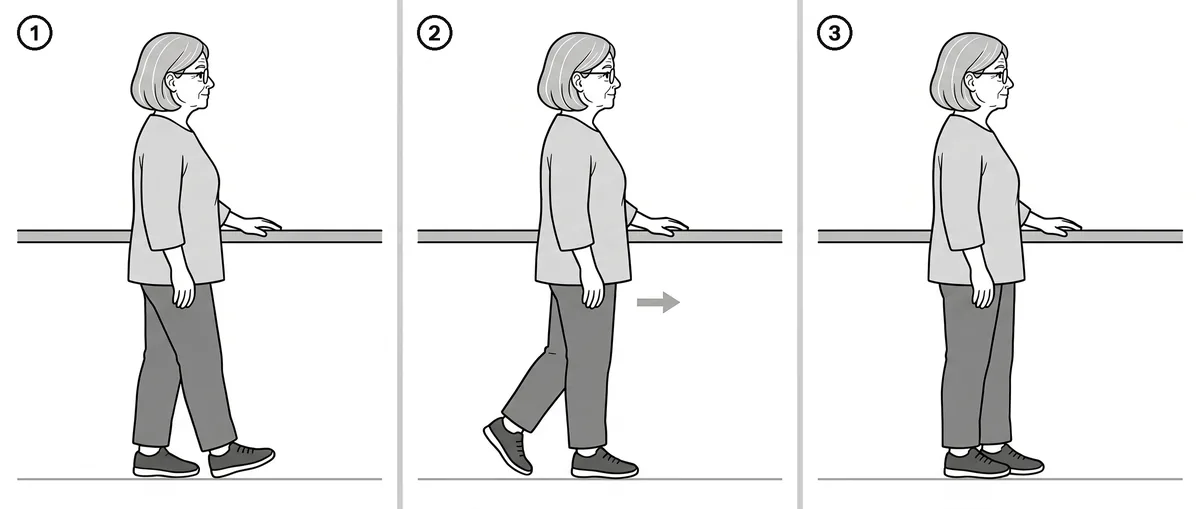
The practice is legit. Tai chi walking is slow, careful walking based on the tai chi step. You place your foot, roll it flat, and then shift your weight. Tai chi itself is centuries old.
Some marketing is not. Ads for "tai chi walking" apps and plans often show dramatic before-and-after claims. Be careful when a plan:
- promises a specific result in a set number of days,
- shows weight loss numbers as if they were typical,
- asks for a subscription before you see what is inside,
- does not mention safety, or tells you to skip talking to your doctor.
You do not need an app to practice. You need a clear space, a counter to hold, and a little time each day.
What has research found about tai chi for older adults?
Here are the main studies behind the advice on this site. Each one looked at specific groups of people in specific programs.
A large review of exercise programs (2019)
In 2019, the Cochrane Collaboration published a review of 108 exercise trials with older adults living in the community. Cochrane reviews pool many studies to see the overall picture. The review found that:
- Exercise programs overall reduced the rate of falls by about 23%.
- Programs built mainly on balance and functional exercise, the kind used in daily life, reduced the rate of falls by about 24%.
- Tai chi may reduce the rate of falls by about 19%. The review rated the evidence for that figure as low certainty.
- Tai chi reduced the number of people who had one or more falls by about 20%.
A tai chi trial with adults aged 70 to 92 (2005)
A randomized trial by Li and colleagues followed 256 adults aged 70 to 92. One group practiced tai chi three times a week for six months. The other group did stretching.
At the end, the tai chi group had fewer falls (38 compared with 73) and fewer people who fell (28% compared with 46%).
An early tai chi study (1996)
A study by Wolf and colleagues included 200 adults aged 70 and older. After 15 weeks, the tai chi group had a lower risk of falling more than once than the comparison group.
What does the research not tell you?
Honest reading matters as much as the numbers.
- It is about groups, not you. A study reports averages. Your own body, health, and history are different.
- The programs were structured. People practiced several times a week for months, often with an instructor.
- "Tai chi walking" was not the program. The studies used tai chi forms and balance training. Tai chi walking uses the same slow step, but it has not been tested on its own.
- No study promises you will never fall. Even in the best programs, some people still fell.
- Plain walking is a different question. The same Cochrane review said its authors were uncertain about the effect of walking programs alone on the rate of falls. Walking is still good for you in many ways. It just is not the same as balance practice, which is why the slow tai chi step is worth learning on its own.
How to read a claim you see in an ad
When you see a bold claim about tai chi walking, ask three questions:
| Question | A good sign | A warning sign |
|---|---|---|
| Who was studied? | Older adults like you, named in a real study | No study named, or only customer stories |
| What was compared? | A group that did something else, such as stretching | No comparison at all |
| What is promised? | Careful words like "may" and "on average" | A fixed result in a fixed number of days |
What do health agencies recommend?
Public health guidance points in the same direction as the research.
- The World Health Organization advises older adults to do activities that work on balance and strength on three or more days a week, as part of being active.
- The US Centers for Disease Control and Prevention says that about one in four adults aged 65 and older falls each year. Its STEADI program encourages older adults to talk with their doctor about falls and to stay active.
- The National Institute on Aging lists balance as one of four types of exercise older adults need, along with endurance, strength, and flexibility.
Tai chi walking is one gentle way to practice balance at home. It works well alongside other activity, such as everyday brisk walking. See tai chi walking vs. regular walking.
How to try it fairly
If you want to see whether tai chi walking suits you, give it a fair, safe trial.
- Talk to your doctor first, especially if you have fallen in the past year.
- Start seated. Spend the first week on chair moves.
- Practice 10 to 15 minutes a day for four weeks.
- Keep a hand on a counter for every standing move.
- Write one line a day: how steady, how calm, how stiff you felt.
After four weeks, read your notes. Many people notice they feel calmer and more aware of their steps. Some notice more. Some notice less. All of these are normal.
The free starter routine includes a 28-day plan for exactly this kind of trial.
Questions people ask
Is tai chi walking a scam?
The practice is not a scam. It is slow, careful stepping taken from tai chi, which researchers have studied with older adults for decades. Be careful with apps or paid plans that promise fast or specific results.
Has tai chi walking itself been studied?
Not as a separate program with that name. The research is on tai chi and on balance exercise for older adults. Tai chi walking uses the same slow step and weight shift.
How long before I notice anything?
In the trials described here, people practiced for about 15 weeks to 6 months, several times a week. Some people notice they feel calmer or more aware of their steps within a few weeks. No one can promise a result.
Can tai chi walking replace my other exercise?
It is best seen as one part of being active. Health agencies advise older adults to combine balance, strength, and moderate aerobic activity such as brisk walking.