Tai Chi Walking for Beginners: The Basic Step, Step by Step
The basic tai chi walking step has three slow parts: place the heel with no weight on it, roll the foot flat, then shift your weight onto it. Only then does the back foot come forward. Practice it beside a kitchen counter, with one hand resting on it, for four to six steps at a time.
Before you start
Read these four points first. They keep the practice safe.
- Use a counter. Stand side-on to a kitchen counter so it is beside you. Rest one hand on it lightly.
- Clear a path. You need about four steps of clear, non-slip floor. No rugs, cords, or pets underfoot.
- Wear flat shoes with a grip, or go barefoot on a non-slip floor. Avoid socks on smooth floors.
- Know when to stop. Stop and rest if you feel sharp pain, dizziness, chest discomfort, or shortness of breath. Talk to your doctor first if you have fallen in the past year.
It also helps to be able to shift your weight from foot to foot at a chair before you learn the step. If that is new to you, start with weight shifts and seated moves for a week.
How to stand
Stand side-on to the counter with one hand on it. Place your feet hip-width apart, as if each foot stands on its own train track. Soften both knees. Stand tall and let your free arm hang loosely.
When you work the other leg, turn around slowly so your other hand rests on the counter.
Part 1: Place the heel (the "empty step")
In tai chi, the foot arrives before the weight does.
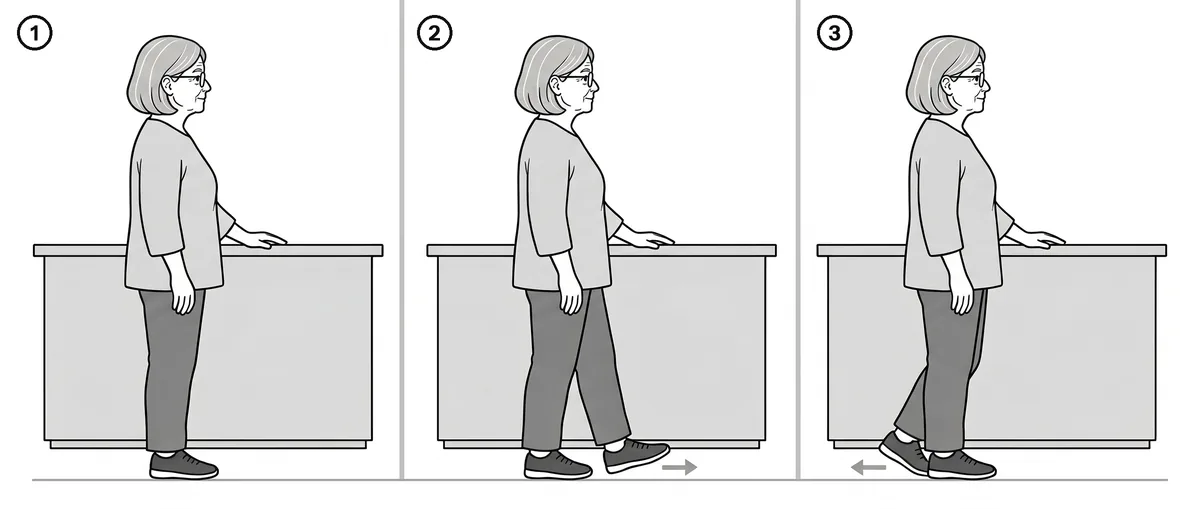
- Shift your weight onto your left foot.
- Lift your right foot slowly and place the heel a short step forward. Keep the toes lifted.
- Your right foot is now "empty." Almost all your weight stays on the left leg. Pause for two counts.
- Bring the right foot back beside the left. Repeat a few times with each foot.
Tip: If you must lean on the counter to reach the heel forward, make the step shorter.
Part 2: Roll the foot flat
A soft landing starts at the heel and spreads along the foot.
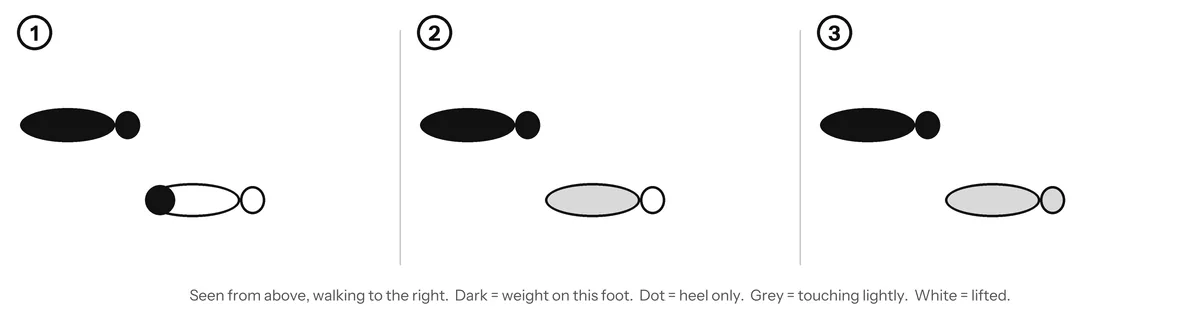
- Start with your right heel forward, as in Part 1.
- Slowly lower the front of the foot until the whole sole rests on the floor.
- Feel three points touch down: the heel, the ball of the big toe, and the ball of the little toe.
- Your weight still stays on the back leg. Only the foot moves. The body waits.
Part 3: Shift your weight and let the back foot follow
Now the weight moves, slowly, from the back foot to the front foot.
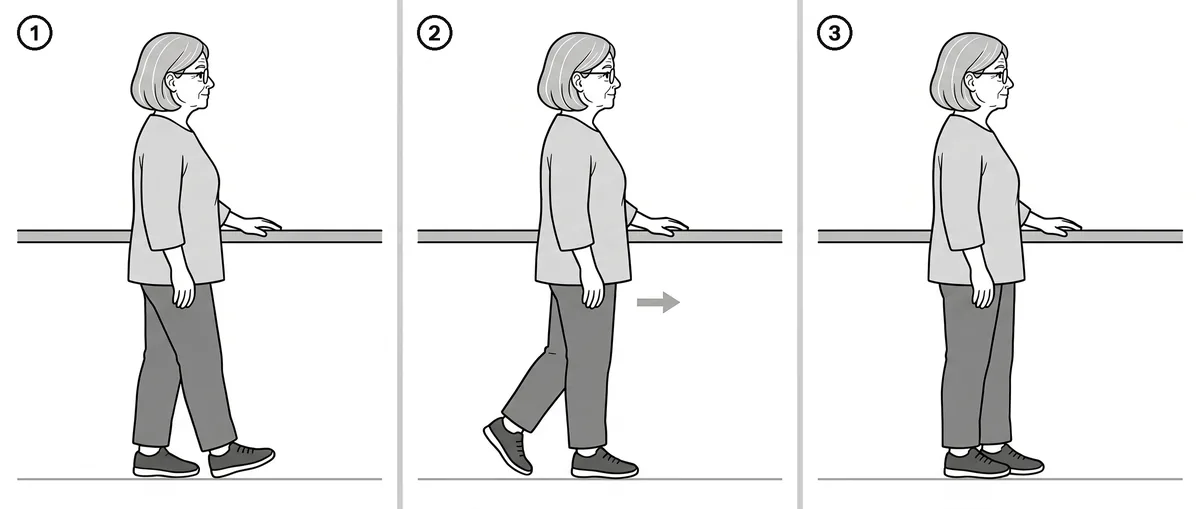
- With the right foot flat in front, let your weight move forward onto it. Breathe out as you shift.
- When the right foot holds most of your weight, the left heel lifts by itself.
- Bring the left foot forward and place its heel down, ready for the next step.
- Keep going, one side and then the other, for four to six steps.
Tip: Do not let your chest lead. Your hips move first, and your head rides on top.
Putting it together
Joined together, the three parts make one smooth tai chi step: heel, roll, shift, step. Say it quietly in your head as you go. It helps you keep the pace slow.
At the end of the counter, turn around in small steps with your hand on the counter. Never spin on one foot. Then walk back.
Common beginner mistakes
| Mistake | Simple fix |
|---|---|
| Stepping too far | Keep each step to about one foot length. |
| Shifting the weight too soon | Wait until the front foot is flat and steady. |
| Looking at your feet | Look ahead at a spot on the wall. |
| Locked knees | Keep both knees soft. |
| Holding your breath | Breathe out on each shift. |
| Gripping the counter | Rest your hand lightly; a tight grip tenses the shoulders. |
How do you know you are ready to walk without stopping?
Check these three things before you make the step part of a longer walk:
- You can do four slow steps along the counter, each side, without holding your breath.
- You can pause in Part 1, heel down, and stay steady.
- You can turn around at the end of the counter in small, slow steps.
If any of these feels hard, keep practicing the three parts for a few more days. There is no prize for speed.
What comes next
Once the step feels smooth, it becomes a slow walk along the counter, then walks in other directions: backward, sideways, and around two chairs in a figure eight. The book Tai Chi Walking for Seniors builds these patterns week by week, with a drawing for every move.
New to the idea? Start with What Is Tai Chi Walking?
Questions people ask
How long should a tai chi step be?
Short. About one foot length is plenty for a beginner. A long step is harder to control.
Should I look at my feet?
Glance down only when you need to. Look ahead at a spot on the wall. Your head is heavy, and looking down tips your balance forward.
What if I feel wobbly?
Make the step shorter, keep your hand on the counter, and slow down. If you still feel unsteady, go back to weight shifts at a chair for a few more days.
How many steps should I do?
Four to six slow steps along the counter, then turn around carefully and walk back. Two lengths are enough at first.