How to Stand on One Leg Safely at the Kitchen Counter
To stand on one leg safely, stand sideways to your kitchen counter with one hand resting on it and a sturdy chair behind you. Shift your weight onto the leg nearest the counter, lift the other foot a few inches and pause for 2 to 5 seconds. Put the foot down the moment you wobble. That's the whole skill, and it stays this small for a reason.
Why single-leg balance matters for seniors
You stand on one leg many times a day without noticing. Every step has a short moment when one foot is off the floor and the other leg carries all of you.
Daily life adds more of these moments. Turning at the sink lifts a foot. So does stepping over the edge of a shower, onto a curb or into a car. Each one lasts only a second or two, which is why short holds are the right practice. A longer hold only tires the leg.
If you're new to standing practice, the balance exercises at a chair are a gentler place to begin. Its slow weight shifts lead naturally to this page.
Before you lift a foot
Read these points before your first try. They apply to every one-leg move.
- One hand on the counter, every time. The counter is steadier than a chair back, and it doesn't tip.
- A sturdy chair without wheels behind you, close enough to sit down at any moment.
- A helper nearby the first few times. They don't need to hold you. They only need to stand close and pay attention.
- Flat shoes with grip. Socks alone can slide on a smooth floor.
- Stop signs. Sit down at once for sharp pain, dizziness, chest discomfort or shortness of breath. If the feeling doesn't pass, call your doctor. If it is severe, call for emergency help.
- Check with your doctor first if you fell in the past year, often feel dizzy, had recent surgery, use a cane or walker, or take heart or blood pressure medicine.
How to stand on one leg safely, step by step
Each step has one thing to feel and one thing to avoid. Go slowly. The first session can be just two or three tries on each leg.
1. Stand sideways to the counter
Turn so your side is close to the counter. Rest the near hand on the edge, elbow soft.
- Feel: the counter right beside your hip, no reaching needed.
- Avoid: standing a step away. If you have to stretch for support, it isn't support.
2. Soften both knees
Stand tall and let both knees bend the tiniest amount.
- Feel: a small give in the knees, as if you could bounce.
- Avoid: locking the standing knee. It feels firm, yet it makes the whole leg stiff and slow to adjust.
3. Drift your weight onto the counter-side leg
Notice the three points under each foot: the heel, the ball below the big toe and the ball below the little toe. Then let your weight drift slowly onto the leg next to the counter. Your support and your weight are now on the same side.
- Feel: that foot pressing evenly into the floor through all three points.
- Avoid: leaning your upper body toward the counter. Only the weight moves. The trunk stays upright.
4. Look at something still
Pick a point ahead, such as a cupboard handle or a mark on the wall, and rest your eyes there.
- Feel: the room holding still around you.
- Avoid: looking down at your feet. It makes balance harder, not easier.
5. Lift the far foot a few inches
Breathe out and raise the knee of your far leg a little, so the foot comes just off the floor. A few inches is plenty. In Tai Chi Walking for Balance this is called the Knee-Lift Pause, the gentlest one-leg moment in the program.
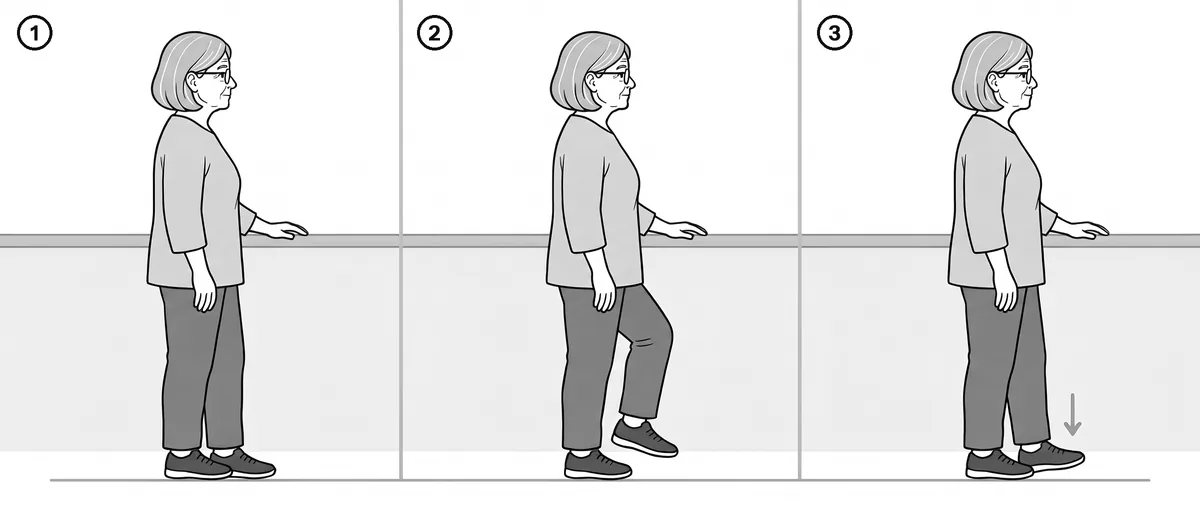
- Feel: both hips staying level, like a tray you don't want to tilt.
- Avoid: hitching one hip up to get the foot off the floor. If that happens, lift only the heel and leave the toes touching.
6. Pause for 2 to 5 seconds, then lower slowly
Breathe softly while the foot is up. Then breathe in and set it down, slow and quiet, and come back to the middle. Do 3 to 5 lifts on that leg.
- Feel: the standing ankle making tiny corrections. That's your balance at work.
- Avoid: holding longer to prove something. If you wobble, put the foot down. That is the correct response, and it is part of the practice.
7. Turn around in small steps to switch sides
Walk yourself around in short steps until the other side of your body is next to the counter. Then repeat steps 2 to 6 on the other leg.
- Feel: a calm, unhurried turn.
- Avoid: spinning on one foot to save time.
A next step: Golden Rooster at the counter
Once the Knee-Lift Pause feels calm, a classic tai chi shape adds a little more. Stand with your left side to the counter, left hand on the edge, weight on the left foot. Lift the right knee low, just enough to clear the floor. At the same moment, let your right forearm float up in front of you with the elbow bent, hand near chest height.
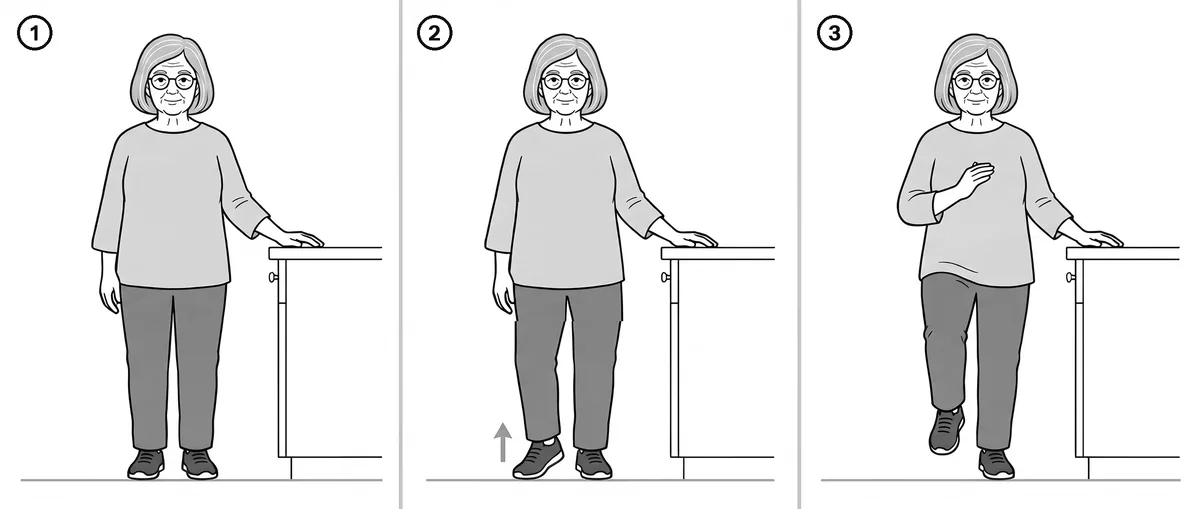
Hold for 3 seconds to start. On good days you can stay up to 10 seconds, but no longer. The lifted knee and the rising arm belong to the same side. Keep that knee low, well below hip height. For an easier version, leave the toes of the lifted foot on the floor and raise the arm only to waist height.
To make it harder, lighten your touch on the counter until only the fingertips rest there. Never let go.
What you may notice
The outside of your standing hip may feel tired after the first few sessions. That's normal, and it usually fades within a day or two.
Some days one-leg moves will feel harder than the week before. Poor sleep, a low mood or a busy day all play a part. On those days, keep both hands on the counter and use the easier versions. That still counts.
Talk to your doctor if a joint swells or if pain lasts more than a day.
Where this fits
One-leg moments come after you are comfortable with weight shifts and slow steps, not before. If you want the reasons slow practice may help, read does tai chi improve balance. The basic tai chi step guide shows how the same weight shift turns into walking.
The free starter routine gives you five gentle moves to build that base. When you're ready for more, Tai Chi Walking for Balance leads you there over 6 weeks, with one-leg work saved for the last two.
Your next step: tomorrow, stand sideways to the counter and try three Knee-Lift Pauses on each leg.
Questions people ask
How many seconds should I stand on one leg?
A few seconds is enough. Start with a 2 to 5 second pause. Longer holds only tire the standing leg and make a wobble more likely.
Can I let go of the counter once I feel steady?
Keep at least your fingertips on the counter for every one-leg move. Lightening your touch is the way to make it harder. Letting go is not part of this practice.
Is it normal for one leg to feel steadier than the other?
Yes. Most people have a stronger side. Give the weaker side the same short, patient holds and the same number of repeats.