Balance Exercises for Seniors at Home (With Pictures)
The simplest balance exercises for seniors at home use a sturdy chair for support: slow weight shifts, heel raises, and standing up from a chair with control. Keep both hands on the chair back, move slowly, and do a few repeats of each move most days. Start seated if standing feels like too much.
Why balance practice matters
Every step you take is a small balance act. You carry your weight on one leg for a moment, then pass it to the other. Turning in the kitchen, stepping off a curb, or reaching for a shelf all ask your body to move its weight in a new direction.
Health agencies agree that balance needs its own practice. The National Institute on Aging lists balance as one of four types of exercise older adults need. The World Health Organization advises older adults to do balance and strength activities on three or more days a week.
Before you start
- Set up the chair. Use a sturdy chair without wheels. Push the front of it against a wall or counter so it cannot slide. Stand behind it with both hands on the backrest, elbows a little bent.
- Wear flat shoes with grip. Avoid socks on a smooth floor.
- Keep a phone nearby.
- Know the stop signs. Sit down at once if you notice dizziness, sharp pain, chest discomfort, or shortness of breath.
- Check with your doctor first if you have fallen in the past year, had a recent surgery, or take medicine for your heart or blood pressure.
1. Side-to-Side Weight Shift
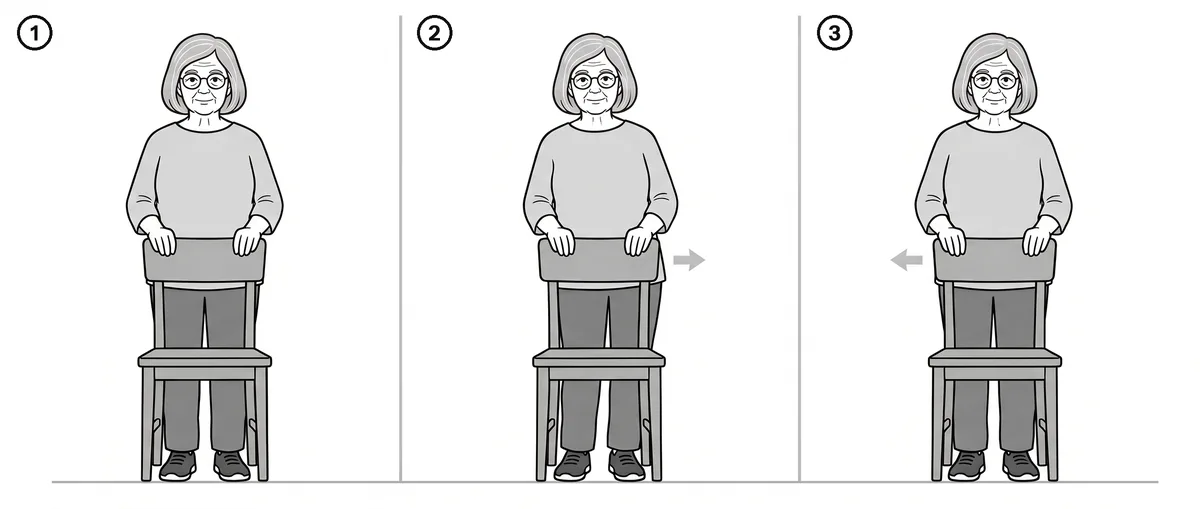
This is a walking step with the stepping taken out. Your feet never leave the floor, so you can feel the weight travel with nothing to trip over.
- Stand behind the chair with both hands on its back and your feet hip-width apart.
- Ease your weight over to your right foot. The left foot stays flat and simply carries less.
- Hold there for two counts. Come back to the middle.
- Now go to the left, hold, and return.
Repeat: 6 times to each side. Easier: a shift so small that nobody could see it still counts. Watch for: the hips do the moving. Your shoulders and head stay level.
2. Heel Raises at the Chair
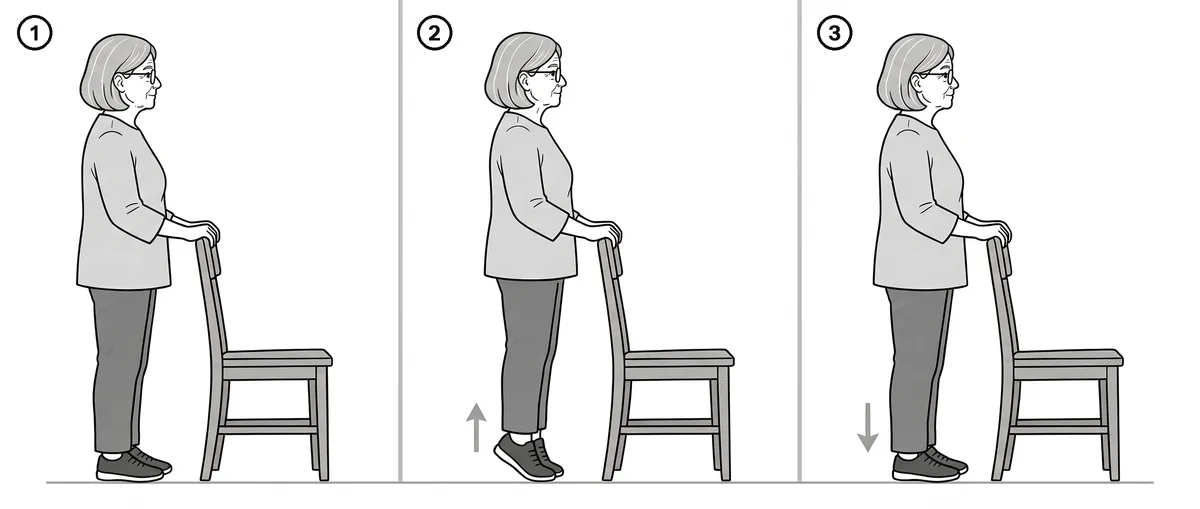
Your calves do the push-off at the end of every step. Here they work while the chair keeps you steady.
- Hold the chair back with both hands.
- Come up slowly onto the balls of your feet. Stop at the height where you still feel steady.
- Hold for two counts.
- Let your heels come back down, slowly.
Repeat: 8 to 10 times. Easier: a small lift is enough. Watch for: press through the big-toe side of each foot. Ankles that roll outward mean the lift is too high, so come up less.
3. Sit-to-Stand
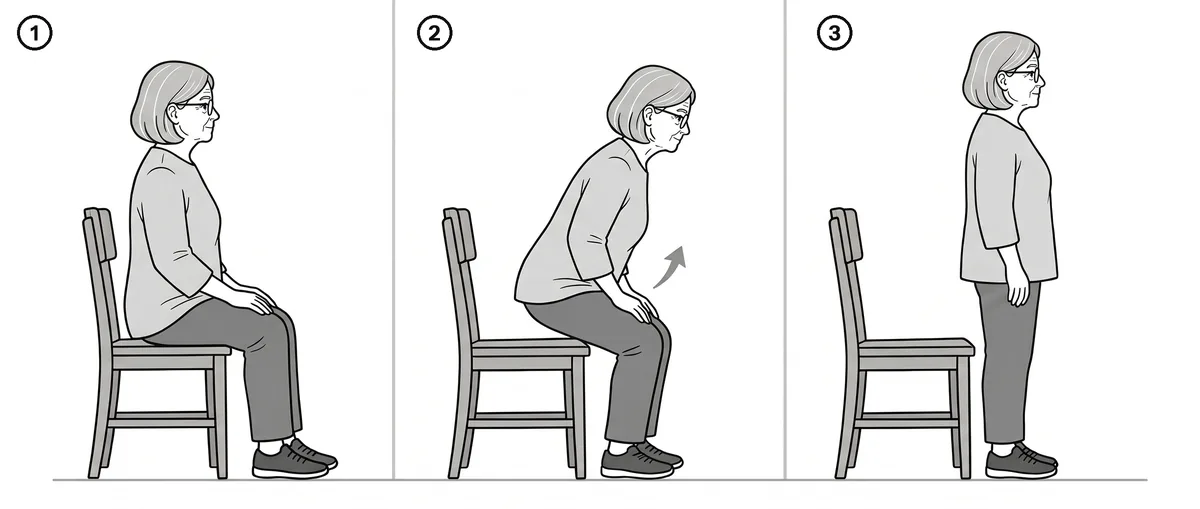
You get up from a chair many times a day. Practicing it slowly, on purpose, makes that everyday move steadier.
- Use a sturdy chair with its back against the wall. Sit near the front edge, feet flat and a little behind your knees.
- Lean forward until your nose is over your toes. Rest your hands on your thighs or the armrests.
- Push down through both feet and come up slowly. Your hands can help.
- Take one breath standing tall. Before you sit, let the backs of your legs touch the seat, then lower yourself slowly.
Repeat: 5 to 8 times. Easier: a firm cushion on the seat makes it higher. Watch for: control the last few inches. Do not drop into the seat.
Three more moves to add later
When the first three feel easy, these are good next steps. Keep both hands on the chair for all of them.
- Forward-and-back weight shift. Stand with one foot a few inches ahead and slowly move your weight forward and back between your feet.
- Sit-back. Bend your knees a little and push your hips back, as if about to sit on a high stool. Go down only a few inches.
- Side step at the chair. Take one small step out to the side and back, then switch sides.
A simple 8-minute routine
| Move | How many | About how long |
|---|---|---|
| Slow breathing, standing tall | 5 breaths | 1 minute |
| Side-to-Side Weight Shift | 6 each side | 2 minutes |
| Heel Raises at the Chair | 8 to 10 | 2 minutes |
| Sit-to-Stand | 5 to 8 | 2 minutes |
| Rest seated, slow breaths | 5 breaths | 1 minute |
Do it most days. Mark each day on a calendar, and follow the 28-day plan in the free starter routine.
Where tai chi walking fits
These moves come after chair exercise and before walking. Once the weight shift feels natural, you can turn it into a slow step: place the heel, roll the foot, shift your weight. The basic tai chi step guide shows how.
If you are not ready to stand yet, start with the six seated moves for a week.
Common mistakes
- Gripping the chair hard. Rest your hands lightly. A tight grip tenses the shoulders.
- Looking down. Look ahead at a spot on the wall.
- Holding your breath. Breathe out on each shift or lift.
- Rushing. Slow is the point. Each move should feel calm.
- Pushing through pain. Mild effort is fine. Pain means stop.
When to get help
Talk to your doctor if you feel dizzy when you stand, if a joint swells after practice, or if you have a fall, even one that seems minor. Your doctor can tell you which moves suit you.
Questions people ask
How often should seniors do balance exercises?
The World Health Organization advises older adults to do activities that work on balance and strength on three or more days a week. Many people find a short daily routine easiest to keep.
Can I do balance exercises if I am over 70?
Yes, many people start in their seventies or eighties. Start with seated moves, keep both hands on a sturdy chair for standing moves, and talk to your doctor first if you have fallen in the past year.
Do I need equipment?
No. A sturdy chair without wheels, pushed against a wall, and a clear, non-slip floor are enough.
What if a move makes me wobble?
Make it smaller, keep both hands on the chair, and slow down. A little wobble while holding on is normal practice. Sit down if you feel dizzy.