Does Tai Chi Improve Balance? Plain Answers After 60
Tai chi may help balance, and it is one of the most studied gentle practices for older adults. Its slow steps give your body safe time on one leg, steady weight shifts and calm attention to the floor. No one can promise a result for you. Many people find that regular practice leaves them feeling steadier and more at ease.
Does tai chi improve balance?
For many older adults, it seems to help. In a large 2019 review of exercise trials for older adults living at home, tai chi groups had fewer falls than comparison groups. Keep in mind what that means: averages from groups in studies, not a forecast for your own body. The full list of studies, and what they did not show, is in does tai chi walking really work.
What the research cannot tell you is how it will feel in your own kitchen. That part you find out by trying it slowly, a few minutes at a time.
What does balance depend on?
Balance is a team job. Three senses report to your brain, and your muscles carry out the reply.
- Your feet feel where your weight is resting on the floor.
- Your eyes show you the walls, the counter edge and anything in your way.
- Your inner ears hold a small fluid-filled organ that senses when your head turns or tilts.
- Your leg muscles respond. The ankles make tiny corrections all day, and the hips join in when you lean further.
Your brain blends these reports many times a second. When one helper has a harder job, you notice. A dark hallway takes away most of what the eyes can offer. On a thick, soft rug, the feet can't read the floor as clearly. A quick turn of the head gives the inner ears a burst of news to sort out.
Why does slow movement help more than fast?
Slowness gives the whole team time to notice and answer. A normal step is over in a blink. A tai chi step stretches the same motion out, so each part of it becomes something you can practice.
Three things happen in every slow step:
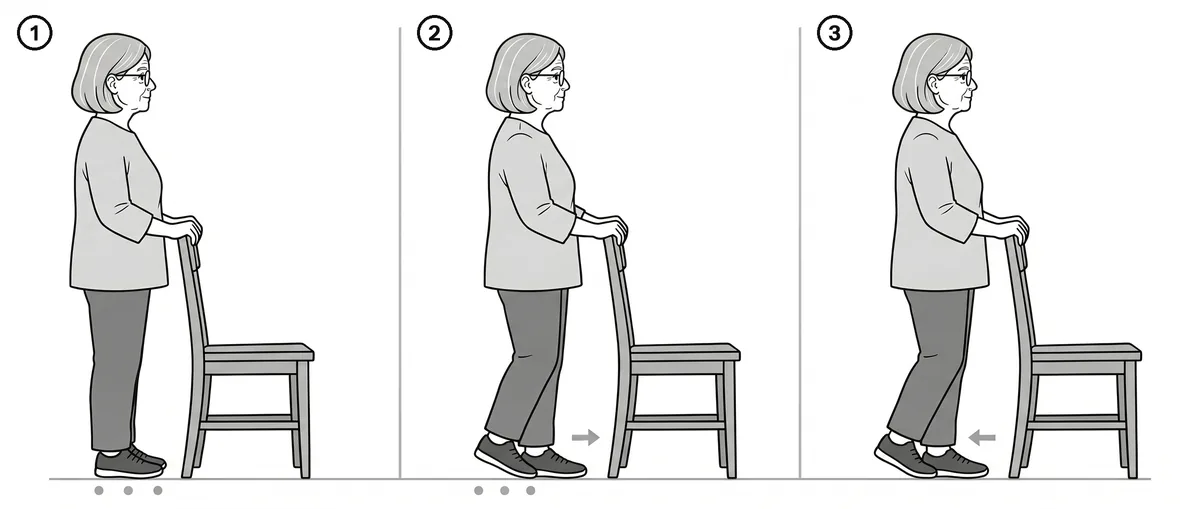
- A short moment on one leg. One leg holds most of your weight while the other foot moves. Going slowly makes that moment a little longer, and you can keep a hand on the counter through it.
- A deliberate weight shift. You move your weight from one foot to the other on purpose and feel it roll from heel to toe.
- Quiet attention. With no rush, you can notice the floor, your breath and small wobbles before they grow.
Can tai chi help with balance if I already feel unsteady?
Many people start exactly there. Balance often feels less sure with the years, and that is common. Moving less plays a part too, because weaker legs and fewer chances to rehearse make the next step feel less certain.
The answer is to begin smaller, not to skip practice. Start with seated moves if standing feels like too much. When you do stand, use the kitchen counter, which is steadier than the back of a chair. Keep a sturdy chair without wheels behind you so you can sit at any moment.
Talk to your doctor before you begin if you fell in the past year, feel dizzy often, had recent surgery, use a cane or walker, or take heart or blood pressure medicine.
What does a home balance session look like?
Short, slow and always holding on. In Tai Chi Walking for Balance, a session runs about 12 to 18 minutes at the counter. Each one opens with a few slow breaths and a quiet minute of standing still.
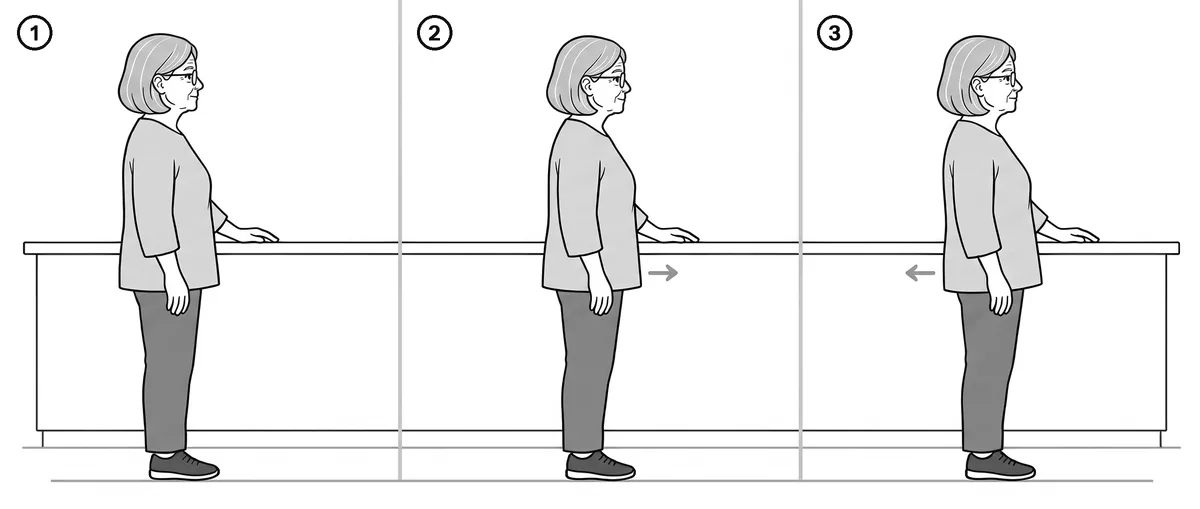
Here is one small piece you can try today. Stand at the counter with both hands resting on the edge. Notice three points under each foot: the heel, the ball under the big toe and the ball under the little toe. Lean a tiny bit forward and feel the pressure move toward your toes. Lean a tiny bit back and feel it move toward your heels. Come back to the middle.
That is all. It takes a minute, and it teaches your feet to read the floor again. If you'd like to know what the rest of tai chi walking involves, start with what tai chi walking is.
Is tai chi for balance and mobility the same as regular walking?
No, and both are worth doing. Brisk walking is good for your heart and your mood. It moves fast, though, so the one-leg moment and the weight shift pass by too quickly to train on purpose.
Tai chi walking slows those moments down. Many people use both: a daily walk outside and a few slow minutes at the counter. The comparison of tai chi walking and regular walking sets them side by side.
When should I stop a session?
Stop at once and sit in your chair if you notice sharp pain, dizziness or a spinning feeling, chest pain or pressure, or shortness of breath that lasts after you rest. Stay seated until it fades. If it doesn't fade, phone your doctor. For a strong or frightening feeling, call for emergency help.
Mild effort in the legs is normal. Pain is a signal to end the move, even halfway through. A wobble is different: put the foot down, breathe and carry on.
How do I start practicing tai chi for balance?
Begin with two or three gentle moves, most days, holding the counter. The free starter routine gives you five moves and a 28-day plan on one page.
When those feel easy, the book Tai Chi Walking for Balance takes you further over 6 weeks. It moves from standing at the counter to stepping and turning, then to short one-leg moments. You can go slower than the plan and repeat any week.
Your next step is simple. Tomorrow morning, stand at the counter for one minute and feel the three points under each foot.
Questions people ask
How long before tai chi helps my balance?
There is no fixed timeline. In the trials on our research page, people practiced for about 15 weeks to 6 months, several times a week. Some people feel calmer on their feet within a few weeks. Others take longer.
Do I need a class to practice tai chi for balance?
No. A class can be pleasant, but you can practice at home. You need a kitchen counter to hold, a sturdy chair behind you, flat shoes with grip, and a clear stretch of floor about 6 to 8 feet long.
Is tai chi walking the same as tai chi?
Tai chi walking takes the slow tai chi step and practices it on its own, without the long forms. It keeps the weight shift and the short moment on one leg.
Can I do tai chi for balance if I use a cane?
Only with your doctor's OK. Ask which standing moves suit you. Seated moves are a good place to begin while you wait for that answer.