Gentle Exercise for Seniors: 5 Common Myths, Explained
Gentle exercise for seniors is often written off as too easy to matter, but slow, careful movement asks real work of your legs and ankles. Most myths about it come from mixing up "gentle" with "pointless." A short, slow session at the kitchen counter on most days is a fair place to start after 60.
Five beliefs keep many people from starting, or make them quit early. For each one you'll find what is true and one thing to try. Check with your doctor before you begin any new exercise, especially if you have fallen in the past year or take heart or blood pressure medication.
Myth 1: "Gentle exercise for seniors is too easy to do anything"
Slow movement is harder work than it looks. When you hold a position for a few seconds, your legs and ankles keep working the whole time. There is no quick push or bounce to carry you through.
Try this to feel it. Stand behind a sturdy chair with both hands on its back. Rise onto the balls of your feet over a slow count of three, then lower over another slow count of three. Do six. Most people feel their calves by the fourth one.
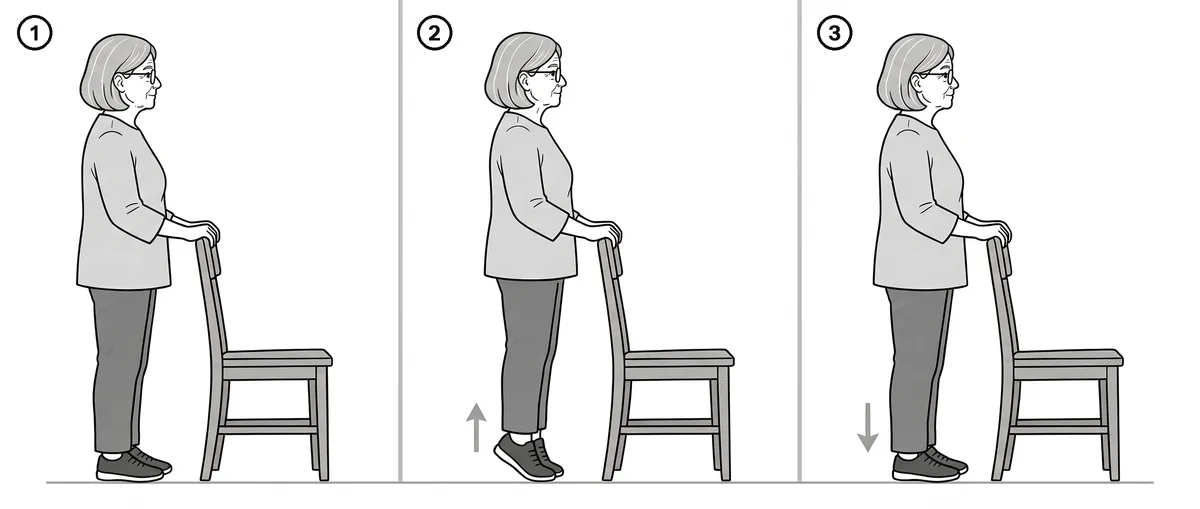
Going slowly has a second use. It gives you time to notice habits that speed hides. One foot may land harder than the other. You may lean forward when you feel unsure. Once you can feel a habit, you can start to change it.
Myth 2: "If it's short, it doesn't count"
A short session counts. The program in our book asks for about 10 to 15 minutes a day, and on a hard day even less is fine. Five slow minutes in a chair is still a practice day, so tick it on your tracker like any other.
Keeping the habit alive matters more than the length of one session. A routine that shrinks to five minutes on a busy Tuesday is still there on Wednesday. A routine you drop for a week is much harder to pick up again.
There is one trap here. Don't squeeze a full routine into fewer minutes by moving faster. Speed takes away the slow control that gives this kind of exercise its point. Do fewer moves, and keep them slow.
Myth 3: "Chair exercises are only for people who can't stand"
Seated moves are a good starting point for almost everyone, including people who walk without trouble. In Tai Chi Walking for Seniors, the whole first week happens in a chair, on purpose. With no risk of tipping, your attention can go to how each move feels. That attention is the skill you carry into standing and walking later.
Seated moves also wake up the feet, the ankles and the small muscles around the hips. Those parts make tiny corrections every time you take a step.
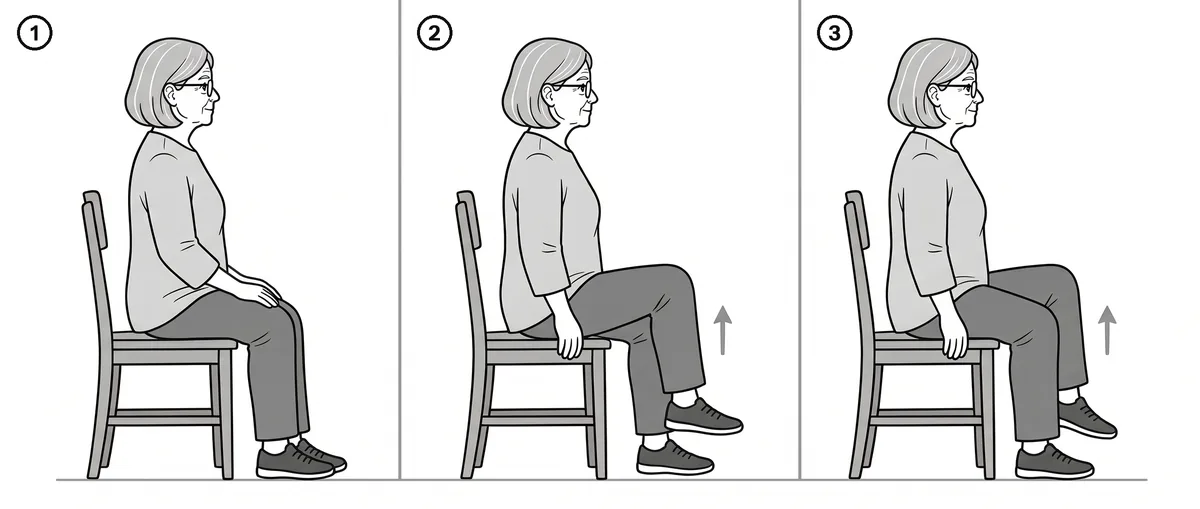
For six chair moves to begin with, see seated tai chi for seniors. Use a heavy armless chair with no wheels. Push it back against a wall so it can't slide.
Myth 4: "A little pain means it's working"
Gentle exercise should not hurt. Mild effort is fine, and some soreness after a new move is common. It normally eases after a day or two. Sharp pain means stop.
That line is easy to blur when you are keen to make progress. Use this table to sort what you feel:
| What you feel | What to do |
|---|---|
| Mild effort in the legs during a move | Carry on slowly |
| Light soreness the next day | Make every move smaller and slower |
| Sharp pain during a move | Stop, sit down and rest |
| Pain that lasts more than a day, or a swollen joint | Rest and call your doctor |
| Dizziness, chest discomfort or shortness of breath | Stop at once and get help |
If one joint is sore, leave out the moves that use it and do the rest. A small, smooth move beats a big one that hurts.
Myth 5: "Skipping a day means you've failed"
Rest is part of a sensible plan. Some days you should not practice at all. Skip it if you have a fever, feel dizzy before you start, have new pain you can't explain, or slept so badly that your legs feel weak.
Before each session, sit down and ask yourself three quick questions:
- Did I sleep fairly well last night?
- Do I feel steady getting up out of the chair?
- Is my head clear?
If any answer is no, make it a seated day or a rest day. On your tracker, mark a rest day with an "R," then carry on the next day. Don't make up for it with two sessions at once. Doubling up tends to leave you sore and less keen to go on.
Where tai chi walking fits
Tai chi walking is one form of gentle exercise built on the ideas above. You set the front foot down empty first. Then you let your weight move onto it slowly, and only after that does the back foot follow. One quick step becomes several slow parts, and you can pause at any of them.
For a plain overview, read what tai chi walking is. When you're ready to stand, learn the basic step, step by step.
Your next step
Pick one chair and one time of day. Tomorrow, do the six slow heel raises from Myth 1, then sit down and take five slow breaths. That is the whole session.
If you'd like a printed routine, the free starter routine gives you a simple plan to pin on the fridge. The full 28-day program, with an easier and a harder version of every move, is in Tai Chi Walking for Seniors.
Questions people ask
What counts as gentle exercise for seniors?
Slow, controlled movement that you can stop at any moment. Examples are seated moves in a sturdy chair, heel raises while holding the kitchen counter, and slow tai chi walking along a clear path at home.
How many minutes a day should I start with?
Many people start with about 10 minutes a day. On a busy or tired day, five slow minutes in a chair still counts. Short sessions on most days are easier to keep than long ones now and then.
Can I do gentle exercise alone at home?
Many people do. Keep a phone within reach, roll up loose rugs, and hold a sturdy chair or the counter for every standing move. Check with your doctor first if you have fallen in the past year.
Should I exercise when I feel stiff?
Mild stiffness is common, often in the morning. Make each move smaller and slower, or practice after lunch instead. If a joint is red, hot or swollen, rest and talk to your doctor.