Farmers Walk vs. Tai Chi Walking: Which Fits After 60?
Farmers walk vs. tai chi walking comes down to one difference: the first is a strength exercise, the second a slow practice of balance and control. In a farmers walk you carry a weight in each hand at a normal pace. In tai chi walking you place each foot first and let your weight follow slowly. They meet different needs, and many people over 60 can use a little of both.
Check with your doctor before you start either one. That matters most if you've fallen in the past year, feel dizzy, or take medication for your heart or blood pressure.
What is the farmers walk?
The farmers walk is a simple carrying exercise. You hold a weight in each hand, let your arms hang by your sides, stand tall and walk. Gyms use dumbbells or kettlebells. At home, two shopping bags with a few cans in each do the same job.
It mostly asks for strength. Your hands grip, your shoulders and the muscles around your middle hold you upright, and your legs carry the extra load. It's also close to daily life. It is the same job as bringing groceries from the car to the kitchen in one trip.
What is tai chi walking?
Tai chi walking is a slow, careful way of stepping. You set the heel down first with almost no weight on it, roll the foot flat, and only then move your weight forward. At any point in the step you could stop and stand still. The basic step guide shows each part with drawings.
The load here is your own body, shifting from one leg to the other. Most people practice beside a kitchen counter, with one hand resting lightly on the edge.
Farmers walk vs. tai chi at a glance
One adds load to a normal walk. The other slows the walk down so you can feel every part of it.
| Farmers walk | Tai chi walking | |
|---|---|---|
| What you hold | A weight in each hand | Nothing, or one light item |
| Pace | Normal walking speed | Very slow, one part at a time |
| Your hands | Both busy | One resting on the counter |
| Main focus | Grip, posture, carrying strength | Weight shift, foot placement, steadiness |
| Where | A clear hallway or gym floor | Beside a kitchen counter |
| Session | A few short trips with rests | 10 to 15 minutes |
| Common mistake | Too much weight, no free hand | Rushing the step, gripping the counter |
What the farmers walk asks of you
The farmers walk asks you to be steady before you start. Say you lift two bags and set off down the hall. Both hands are full. If your toe catches a rug edge, there's no free hand to reach for the counter, and the load can hide the floor in front of you.
So the farmers walk suits people who already feel sure on their feet. If you try it, a few habits help:
- Start light. Two small, equal weights are plenty at first.
- Keep both sides the same so you don't lean.
- Let your shoulders drop away from your ears.
- Walk on a flat, clear floor in good light, in flat shoes with grip.
- Pick the weights up from a chair seat, and put them back there.
That last point is easy to skip. Bending to the floor with a load in each hand is harder than it looks. Tai Chi Walking for Balance has a separate move for picking things up from a chair seat, with bent knees, hips pushed back a little, and a slow rise.
What tai chi walking asks of you
Tai chi walking asks for patience more than strength. Each step holds your weight on one leg for a slow moment, so the standing leg does real work. Many people feel it in the thighs after a few lengths of the counter.
The usual mistakes are different, too. People take a long stride, move the weight before the front foot is flat, or stare at their toes. Keep the step to roughly one foot length. Pick a spot on the wall ahead and let your eyes rest there. Those two changes fix most early wobbles.
The middle ground: slow carrying at the counter
You don't have to choose between heavy carrying and empty hands. In Tai Chi Walking for Balance, the last two weeks of the six-week plan add a move called Carry-and-Walk. It joins a very small carrying task to the slow tai chi step.
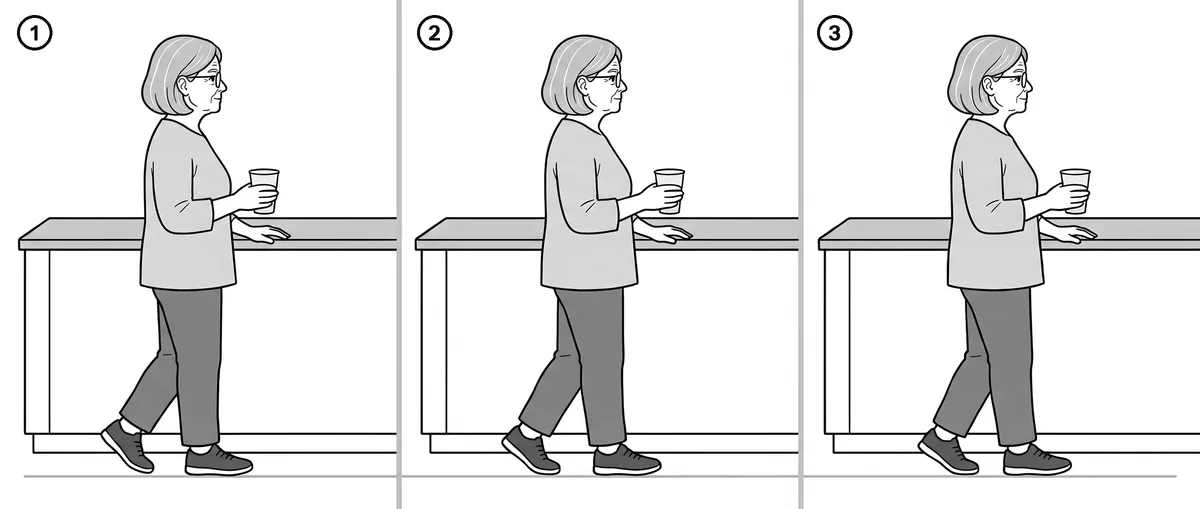
Here is the idea in short:
- Hold something light that can't break, like a plastic cup, in the hand farther from the counter.
- Rest your other hand on the counter. Let it slide along the edge as you go.
- Walk the length of the counter using the slow tai chi step.
- At the end, turn with small steps. Move the cup to your other hand and walk back.
Do two lengths in each direction. Keep your eyes forward, off the cup. Once that feels easy, the book swaps the cup for a folded towel held close to your body.
It's far lighter than a farmers walk, and that's on purpose. It practices a moment that comes up at home every day: walking with one hand busy. For more slow walks to try at the counter, see these walking balance exercises for seniors.
Choose the farmers walk if…
- You already walk with ease and rarely feel wobbly.
- Your main goal is strength for daily carrying, such as groceries or a laundry basket.
- Your doctor is happy for you to add light weights.
- You have a clear hallway and a chair seat to rest the weights on.
Choose tai chi walking if…
- You feel unsure when you turn, reach, or carry something.
- You'd like to practice at home, with a counter beside you for support.
- You want a slow, calm practice that also trains your breathing.
- You're starting from very little activity and want to build up gently.
Somewhere in between? Start with tai chi walking, then add Carry-and-Walk. A light farmers walk can come later, once your steps feel steady. If you also take regular walks outdoors, tai chi walking vs. regular walking shows how the slow practice fits next to them.
Everyday carrying habits that help either way
The same care belongs in ordinary carrying around the house. Full hands can't catch you, and a big load blocks your view of the floor. A few small changes make daily carrying easier:
- Carry less at a time and make two trips.
- Use a bag with a shoulder strap so one hand stays free.
- Try a small cart, or an apron with pockets, for moving things between rooms.
- Keep a waist-high spot by the front door where you can set bags down.
Stop any practice if you feel pain, dizziness, chest discomfort, or shortness of breath. Sit down and rest.
Your next step
Today, walk one length of your kitchen counter with the tai chi step, hands free and slow. Tomorrow, try the same length holding a plastic cup. The free starter routine gives you an easy daily base to build on. The full six-week plan, with Carry-and-Walk in its final weeks, is in Tai Chi Walking for Balance.
Questions people ask
Is the farmers walk safe for seniors?
Many older adults do a light version once their doctor says it's fine. Start with two small, equal weights, walk on a clear floor, and set them down on a chair seat instead of the floor. Skip it for now if your balance feels shaky.
Can I do the farmers walk and tai chi walking in the same week?
Yes. Many people keep them on separate days. Others use a few slow lengths of tai chi walking as a warm-up, then do a short, light carry afterward.
What should I hold for slow carrying practice at the counter?
Something light that can't break, such as a plastic cup or a folded towel. Hold it in the hand farther from the counter and rest your other hand on the edge.