Walking Balance Exercises for Seniors: 3 Tai Chi Walks
Walking balance exercises for seniors take a slow step in new directions: backward, around a curve and along a narrow line. Do them beside a kitchen counter or a wall, so a hand can always reach support. Ten calm minutes on most days is enough to start.
Why walking balance needs its own practice
Walking balance is the steadiness you need while your feet are moving. A daily walk mostly goes straight ahead. Real rooms ask for more than that.
You step back to open the fridge. Getting past the bed means a sideways squeeze by the dresser. Then you curve around a table to answer the door. Each direction asks your feet and eyes to work a little differently. The ones you rarely use can feel shaky at first.
Practicing those directions slowly, on purpose, lets your body get used to them. That is the idea behind week three of Tai Chi Walking for Seniors: take the tai chi step you already know and walk it in new patterns.
Before you start
Check with your doctor first if you fell in the past year, had recent surgery or a joint replacement, or take heart or blood pressure medicine. Stop and sit down if you feel sharp pain, dizziness, chest discomfort or shortness of breath.
You need four things:
- A clear path along a counter or wall, about six to eight of your steps long.
- Two sturdy chairs without wheels, for the figure-eight.
- Flat shoes with laces tied. No socks on a smooth floor.
- The lights on, even at midday, so you can see the floor.
Pick up rugs, cords and pet bowls before you begin. Keep your phone in a pocket.
How to do walking balance exercises for seniors, step by step
Each walk below uses the slow tai chi step: place the foot first, then move your weight onto it. One step takes about three or four slow counts. If that step is new to you, learn it first with the beginner's step-by-step guide.
1. Warm up with a forward walk
Stand side-on to the counter, one hand resting on it, eyes on a spot at eye level on the far wall. Walk slowly to the end of the counter. Turn around in small steps and walk back. Do this twice.
Feel: the back foot go light before it moves. Avoid: looking at your feet. Your eyes stay on the wall ahead.
2. Step backward, toes first
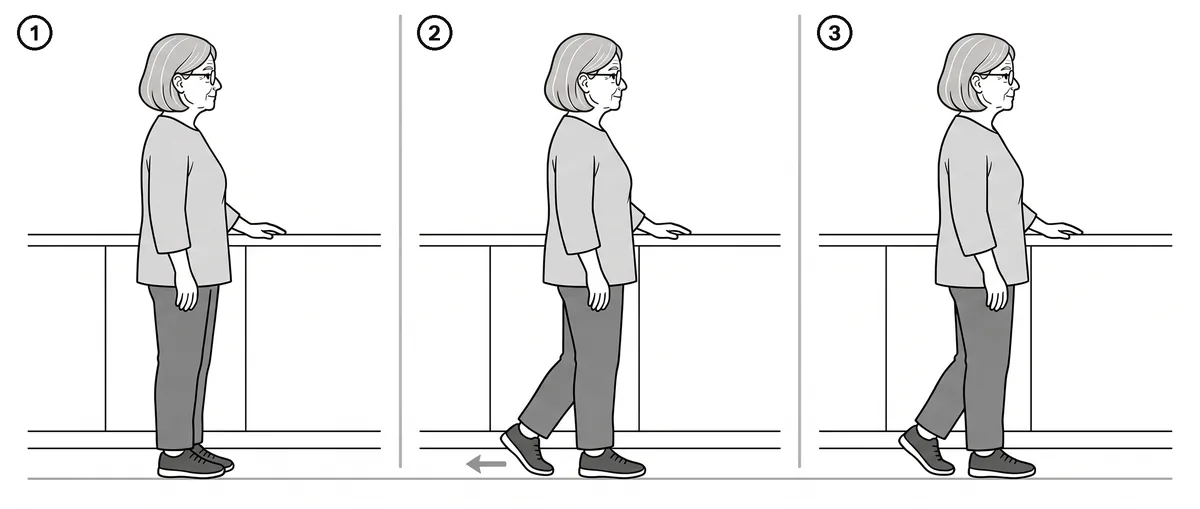
Glance behind you once to make sure the floor is clear. With your weight on the left foot, reach the right foot back a short way. Let the toes land, then the heel, and only then move your weight onto it. Take four steps like this, then walk forward to where you began.
Begin with the in-place version. Step one foot back, step it home, then switch feet. Four on each side. Move to real walking steps only when this feels calm.
Feel: the toes find the floor before any weight goes back. Avoid: a long step. Half the length of your foot is the most you need.
3. Walk a figure-eight around two chairs
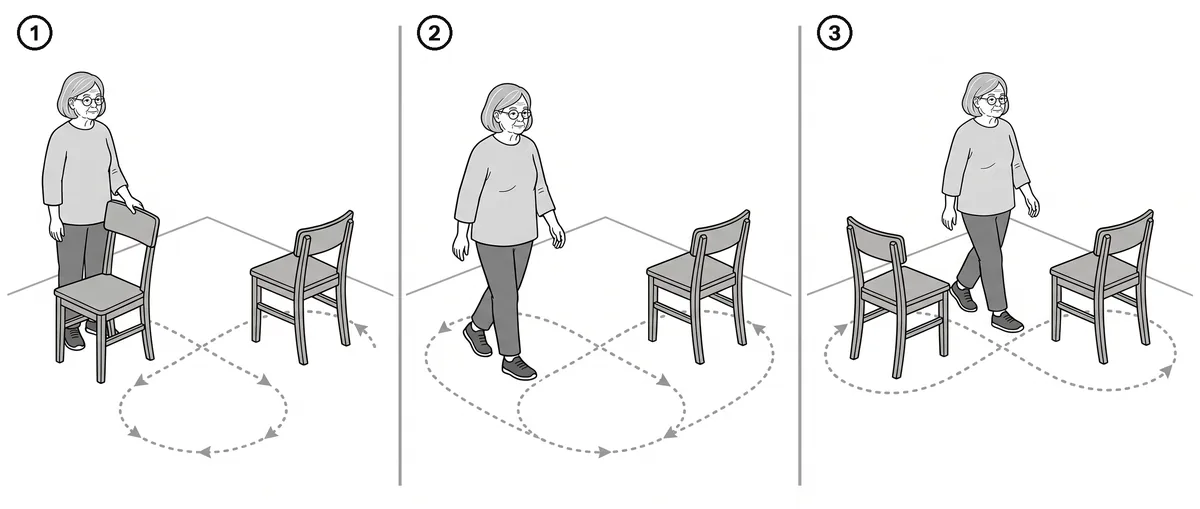
Set the two chairs about two big steps apart with their backs toward each other. Start beside the first chair, one hand on its back. Walk a wide loop around it, cross the middle, and loop around the second chair in the other direction. Your path draws a large 8 on the floor. Walk it twice.
This walk gives you turns in both directions in one go. For more on turning in a tight kitchen, see how to turn without losing balance.
Feel: your chest, hips and feet turning together as one piece. Avoid: small, tight loops. Keep them wide until two full eights feel easy.
For an easier start, circle just one chair, once each way.
4. Walk a narrow path, then a line
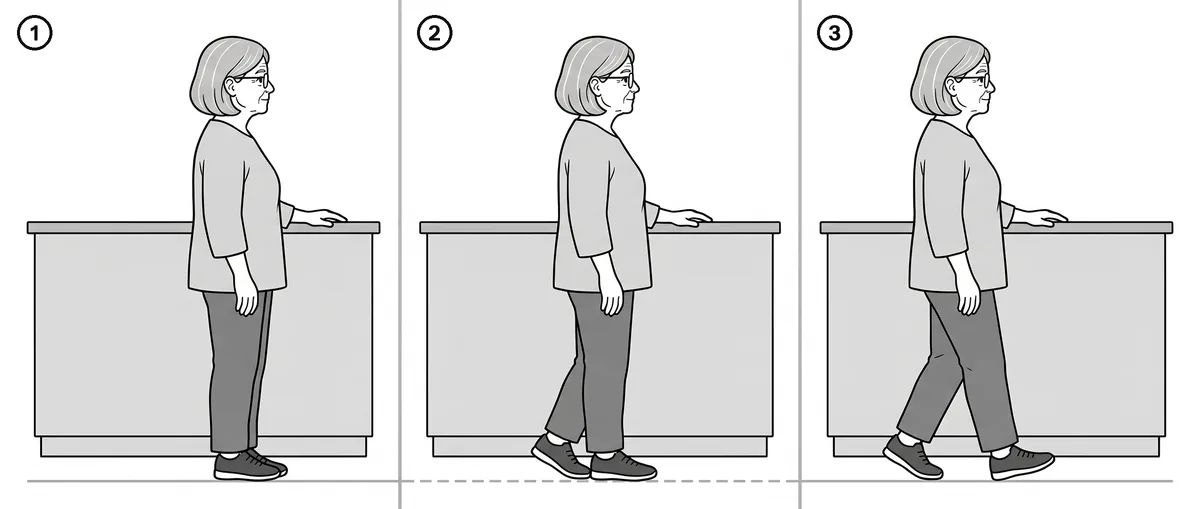
Stand close enough to the wall to touch it, one hand resting there. Begin with the easier version. Keep your feet a few inches apart side to side, as if you were walking along a narrow strip of carpet. Take four to six slow steps, turn and come back.
When that feels steady on several days, narrow it. Set the front heel just ahead of the back toes. Later still, the heel can touch the back toes.
Feel: a calm out-breath as the weight moves onto the front foot. Avoid: letting go of the wall. If you sway, widen your feet and pause.
5. Finish standing still
Turn to face the counter and rest both hands on it. Stand tall with soft knees for three slow breaths. Notice which walk felt easiest today and which one felt new.
Feel: your weight settling evenly over both feet. Avoid: walking off straight away. Give your body those three breaths.
How to build these walks into a week
Add one new walk every day or two. Trying all of them on the first day is too much. In the book's plan, the first day of week three is only the forward walk. The backward walk joins next, in its easier form. The figure-eight follows, and the heel-to-toe line comes last, also in its easy version.
A first week could look like this:
- Days 1 and 2: forward walk and the in-place backward step.
- Days 3 and 4: add the figure-eight around one chair.
- Days 5 and 6: try both chairs and add the narrow-path walk.
- Day 7: repeat what you like, or rest.
Some days the narrow walk will feel steady, and some days it won't. Sleep and energy change it. That is normal.
A good sign that you're ready to move on: you can walk two lengths of the counter without rushing, step back with an even breath, and finish one wide eight without stopping to hold on. On the days in between, the standing weight shifts in these balance exercises at home make a gentle warm-up.
Where to go from here
The free starter routine gives you five beginner moves with drawings and a 28-day tracker to tick off. The full walking week, with forward, backward and side walks, the figure-eight, the heel-to-toe line and a day-by-day table, is in Tai Chi Walking for Seniors.
Your next step: tonight, set two kitchen chairs back to back, two big steps apart, so they are ready for tomorrow morning.
Questions people ask
Which walking balance exercise should a senior start with?
Start with a slow forward walk beside a kitchen counter, one hand on the edge. Add the backward walk in its in-place version next, then the figure-eight, and the heel-to-toe line last.
How often should I practice walking balance exercises?
Most days, for about ten minutes, with a rest day whenever you need one. Short and regular suits most people better than one long session a week.
Is walking heel to toe safe for older adults?
It is the hardest of these walks, so keep a hand on the wall the whole time and begin with your feet a few inches apart. Talk to your doctor first if you have fallen in the past year.