How to Turn Without Losing Balance: Small-Step Turns
To turn without losing balance, take several small steps around instead of spinning on one foot. Keep a hand on the kitchen counter, turn toward it, and let both feet keep stepping until you face the new direction. Short, slow steps keep your feet under you for the whole turn.
Why turning around feels shaky
A turn asks a lot of you in a short moment. Your weight moves sideways while your feet change direction, and the room sweeps past your eyes. Many people feel that wobble at the sink or the stove far more than on a straight walk.
Habit makes it harder. Most of us plant one foot and swivel on it. That twists the knee, and for a second you balance on a narrow base with one leg doing all the work. Small steps keep two feet in play, so your weight always has somewhere to go.
Before you practice
Practice beside a kitchen counter, with nothing on the floor along it for about four or five small steps. Flat shoes that grip the floor are best. A sturdy chair without wheels at one end gives you a place to sit whenever you want.
Sit down straight away if a turn brings on dizziness, chest discomfort, sharp pain or trouble breathing. Get your doctor's OK first if you've had a fall within the last year, feel unsteady most days, or walk with a cane or walker. For the first few sessions, ask someone to stay nearby.
How to turn without losing balance, step by step
This is a small-step turn at the counter. You turn toward the counter, so it stays within reach the whole way.
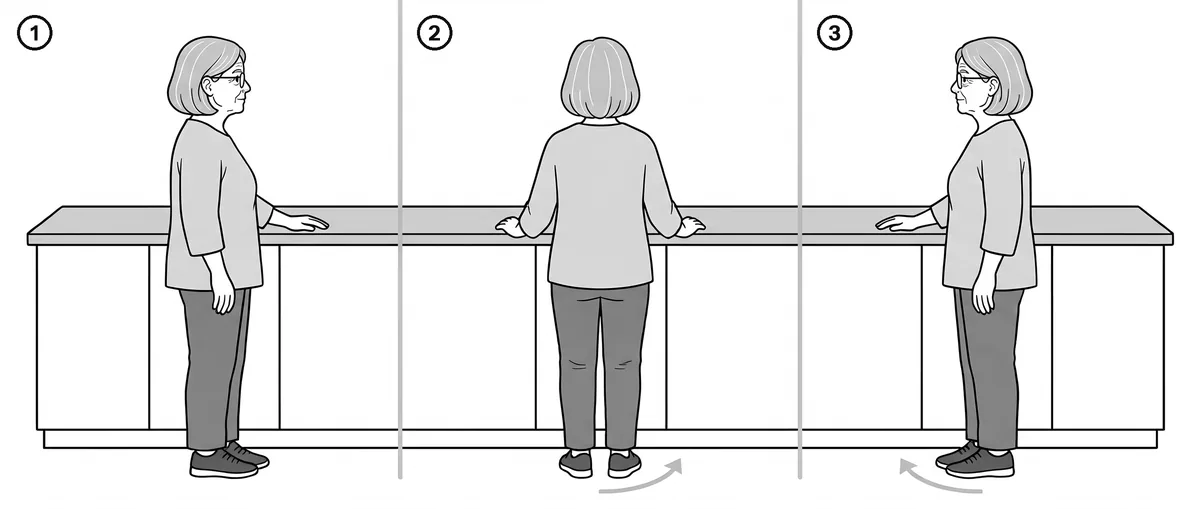
1. Stand side-on and pick your direction
Stand with your right side next to the counter and your right hand on the edge. You'll be turning right, so the counter sits on the inside of the turn. That choice matters: your support comes closer as you go round.
Feel: your weight spread evenly over both feet before you move. Avoid: turning away from the counter, into open floor.
2. Take the first small step
Move your right foot a few inches, toes angled slightly toward the counter. Then the left foot catches up, also by a few inches. That pair is one step of the turn.
Feel: both feet back on the floor after every step. Avoid: a long reach with one foot. A few inches is plenty.
3. Keep stepping until you face the counter
Carry on with short steps. Let each step take about one easy breath. Soon the counter is straight in front of you, so put both hands on it and let one breath go by.
Feel: a calm pause with both palms on the edge. Avoid: hurrying through the middle. This is your built-in rest point.
4. Finish the turn
Go on with the same small steps. Stop once the counter runs along your left side and your left hand rests on the edge. Stand tall. You've turned all the way round.
Feel: your head settling over your hips as you straighten. Avoid: one last quick swivel to get it over with.
5. Turn back the other way
Pause, then turn back, still toward the counter. Four turns with a short rest after each is a good amount for one session.
Feel: that the second direction may feel a little different. That's normal. Avoid: a heel that stays planted while your body twists. If you notice it, make the next step smaller.
If dizziness comes on at any point, stay where you are once you're facing the counter, both palms on the edge, until it settles.
Add a look to the side
Turning your head while you walk can unsettle you, because your eyes and inner ear suddenly report something new. A head-turn walk lets you practice that slowly, with the counter beside you.
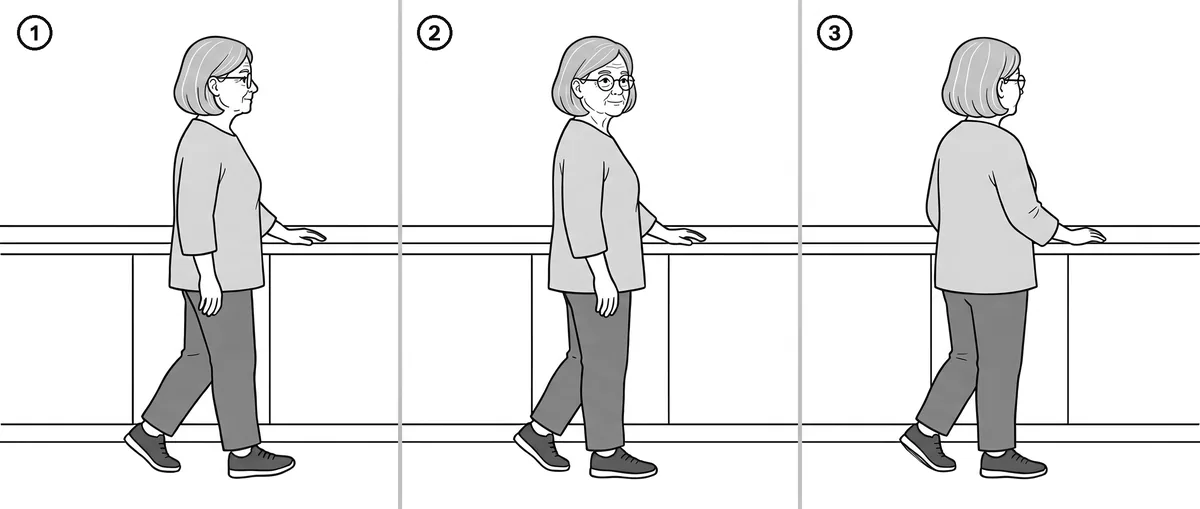
Start without walking at all. Stand facing the counter, palms on the edge, and make five slow head turns, left and right. Once that feels easy, add steps. Walk three slow steps looking ahead, and on the fourth, glance gently to the left and back to center. After three more steps, look to the right.
Keep breathing while you look. If dizziness shows up, stop walking, rest both palms on the edge and wait. Should it keep coming back, talk to your doctor.
Turning in a real kitchen
Kitchens are full of turns. The same idea carries into ordinary moments:
- Sink to stove. Use small steps instead of one swivel, even for a half turn.
- Carrying a pot. Set it on the counter, turn, then pick it up again. Your free hand can rest on the edge while you step.
- Backing away from an oven or fridge door. Glance behind you first, then take a step no longer than your foot.
- The end of a walk. Bring your feet together, turn so both palms rest on the counter, and step around until you face back the way you came. This simple version works from your very first day.
Picture this: the kettle clicks off behind you. Instead of twisting at the waist and reaching, you take a few short steps around to face it, then reach. It costs you two seconds.
Where this fits in your practice
Small-step turns belong at the end of a slow walk along the counter. If the walking step is new to you, the beginner's step-by-step guide covers heel, roll and shift. Gentle weight shifts from these balance exercises at home make a good warm-up before you turn.
For an easy daily base, use the free starter routine. A full six-week plan that adds backward steps, side steps, stepping over a line and more turning practice is in Tai Chi Walking for Balance.
Your next step: after the dishes tonight, step around from the sink a few inches at a time, one hand on the edge, and count the steps.
Questions people ask
Why do I feel wobbly when I turn around?
A turn moves your weight sideways while your feet change direction and the room slides past your eyes. Pivoting on one foot also narrows your base. Small steps with both feet keep you steadier.
Should I turn toward the counter or away from it?
Toward it. Your support gets closer as you turn, and halfway round you can rest both hands on the edge and take a breath.
How many steps should one turn take?
There is no set number. Each step is only a few inches, so a full turn usually takes quite a few. More steps that are smaller is the safer choice.
What if turning makes me dizzy?
Stop where you are, hold the counter with both hands, and breathe until the feeling passes. If dizziness keeps coming back when you turn, talk to your doctor before you practice again.