How to Improve Balance for Seniors: 6 Myths to Drop
How to improve balance for seniors comes down to short, slow, supported practice done most days at a steady kitchen counter. You don't need a gym, special gear or long sessions. Often, a few common beliefs hold people back more than their legs do.
Below are six of those beliefs. Each one comes with what is actually true and one small thing to do instead. Check with your doctor before you start any new balance routine, especially if you've fallen in the past year or often feel dizzy.
Myth 1: "Balance just goes downhill after 60"
Balance can feel less sure with the years, and that is common. Age is one reason. Moving less is another, and that part you can change.
Your balance works as a team of four helpers. The soles of your feet read the floor. Your eyes show where you stand in the room. Deep in each ear, a small organ notices when your head tilts or turns. The leg muscles answer all three and keep you upright. Each helper can get a little slower with age, and each one also gets less practice when you sit more.
That team keeps learning when you give it work. Slow steps, gentle weight shifts and brief moments on one leg all give your brain another chance to practice.
What to do: Give your balance a reason to work each day. One slow walk along the counter is a fine start. For more on why slow moves suit this, read does tai chi improve balance.
Myth 2: "Holding on to the counter is cheating"
Holding on is how you practice safely. It lets you try moves you would never try with empty hands.
Think of support as something you turn down slowly, over weeks. Start with a whole hand resting on the counter edge. Rest it there without gripping. Later, when a stance feels calm, try only your fingertips. That change from whole hand to fingertips is real progress, even when nothing else looks different.
Keep a sturdy chair behind you as well, so you can sit down at any moment.
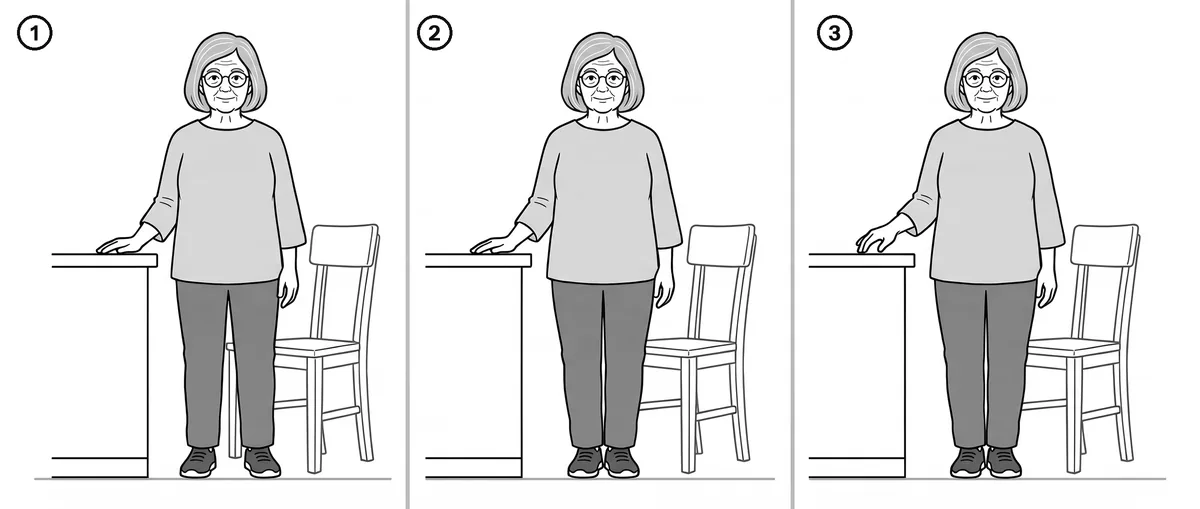
What to do: Never let go of the counter completely during standing practice at home. A lighter touch is fine. Taking the hand away is not part of home practice.
Myth 3: "The longer you stand on one leg, the better"
Short holds suit most people better. A few seconds on one leg is plenty.
Look at a normal step. One foot is in the air for only a second or two while the other leg carries you. Stepping into the shower or up onto a curb asks for about the same. That brief moment is the skill worth practicing. Long holds mostly tire the standing leg, and a tired leg wobbles more.
A knee-lift pause is one gentle way in. Stand side-on to the counter with your near hand on the edge. Let your weight drift onto the leg closest to the counter. Raise the other knee until that foot just clears the floor. Hold that small lift for 2 to 5 seconds. Lower it with care.
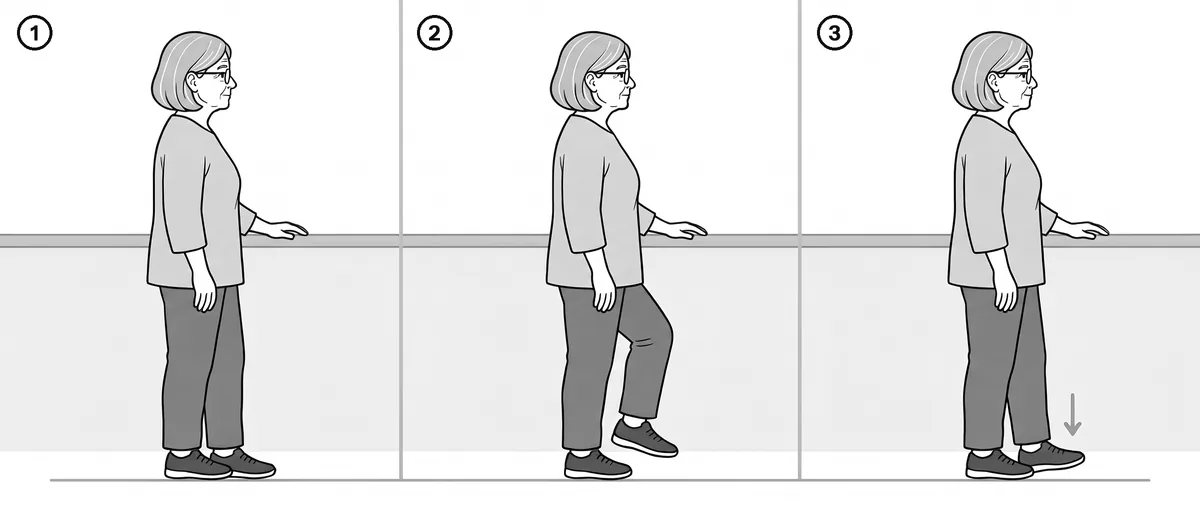
What to do: Keep the standing knee soft, with a tiny bend. A locked knee feels firm, but it makes the whole leg stiff and slow to adjust. The guide to standing on one leg safely walks through the setup step by step.
Myth 4: "If I wobble, I'm doing it wrong"
A wobble is part of the practice. It shows your body is adjusting.
When a wobble comes, put the lifted foot down. That's the right answer every time. It is also the very move you want in daily life: a calm, quick return to two feet. Take a breath, reset your stance, and then try again or move on.
What to do: If the wobbles keep coming, make the move smaller. Take a shorter step, use a lower lift, or put your whole hand back on the counter.
Myth 5: "Watching your feet keeps you steady"
Looking down tends to make balance harder. Your eyes do their best work with a still point ahead of you.
Say you're at the counter and your gaze drops to your toes. The head tips forward, and the chest follows it. Before you notice, your weight has crept onto the front of your feet.
Instead, choose something still at eye level, such as a cabinet knob or a picture frame. Rest your eyes there. Feel the floor through your soles rather than watching it. Good lighting helps too, since your eyes need light to do their share.
What to do: Before each standing move, find your still point first. Then begin.
Myth 6: "You need a long workout for it to count"
Short sessions count. A home balance session of 12 to 18 minutes can be complete on its own.
Doing it most days matters more than doing it long. Keep the same calm shape each time. Open with a few slow belly breaths, letting each out-breath run a little longer than the in-breath. Spend a quiet minute standing tall with soft knees. Then do your moves, and close the same way every day so your body knows the session is over.
Setting up takes about two minutes. Clear rugs and cords from the floor near the counter. Wear flat shoes that grip, put a chair behind you and switch on the lights.
What to do: Pick a regular time, such as after breakfast. Keep the session short enough that you'll want to come back tomorrow.
How to improve balance for seniors: a simple first month
Begin with a small check, then practice and keep notes. Before any of it, know when to pause: sit down and rest if you feel dizzy, short of breath, or notice sharp pain or chest discomfort. Call your doctor if that feeling does not pass.
- Do a gentle starting check so you have something to look back on. The home balance check for seniors spreads it calmly over five days.
- Practice at the counter most days, for 12 to 18 minutes or less on a tired day.
- Write down how you held the counter each time: whole hand or fingertips.
- Repeat the check after a few weeks and read the two side by side.
A number may go up, stay the same, or dip after a poor night's sleep. Treat each number as a note about that week, not a grade. A calmer stand with the same seconds counts too.
Your next step
Tomorrow, stand at the kitchen counter for one minute with soft knees, your eyes on a still point and one hand resting lightly on the edge. If you'd like a printed plan to follow, the free starter routine is an easy place to begin. For the full six-week program, from first stances to one-leg moments and everyday steps, see Tai Chi Walking for Balance.
Questions people ask
Can seniors really improve their balance?
Many people find they feel steadier with short, regular practice. Balance relies on your feet, eyes, inner ears and leg muscles, and they keep responding to practice at any age. Check with your doctor before you start.
How long should I hold a one-leg balance?
A few seconds is enough for most people. Short holds train the brief one-leg moment that every step asks for. Longer holds tend to tire the leg and bring on more wobbles.
Is it okay to hold on to something during balance exercises?
Yes. Keep one hand on a kitchen counter for every standing move. As a move starts to feel calm, you can lighten the touch to your fingertips, but keep them on the edge.
Keep reading
- Balance Test for Seniors at Home: A Gentle 5-Day Check
- Standing Balance Exercises for Seniors: A 7-Day Plan
- How to Turn Without Losing Balance: Small-Step Turns
- Walking Balance Exercises for Seniors: 3 Tai Chi Walks
- How to Stand on One Leg Safely at the Kitchen Counter
- About the book: Tai Chi Walking for Balance